


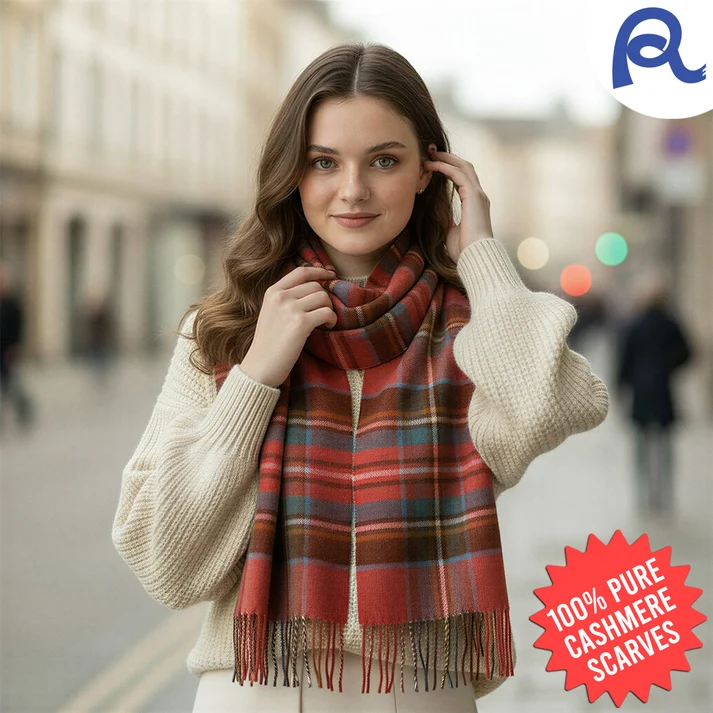
Quick Answer
The best cashmere scarf for women is a 100% pure cashmere scarf, made from long, fine fibres, tightly woven or knitted for durability, and finished in a versatile shade such as camel, grey, or navy. Cashmere delivers exceptional softness and warmth-to-weight ratio, making it the ultimate luxury choice, though it needs gentler care than lambswool or merino.
Why Women Love Cashmere Scarves
There’s a reason cashmere has stayed the benchmark for luxury for centuries. A cashmere scarf for women feels different from the moment you put it on. Lighter than wool, softer against the skin, and warmer than its weight suggests.
Cashmere comes from the soft undercoat of cashmere goats, mainly reared in Mongolia and parts of China. Each goat produces only a small amount of usable fibre per year, which is part of why genuine cashmere carries a premium price.
Why it matters:
- Cashmere fibres are finer than sheep’s wool, giving an exceptionally smooth handle.
- The fibre’s natural crimp traps warm air without adding bulk.
- A well-made cashmere scarf drapes beautifully rather than sitting stiffly.
How it works:
Cashmere’s fine diameter and hollow fibre structure trap air efficiently, giving high insulation for very little weight. That’s why a thin cashmere scarf can feel as warm as a much bulkier wool one.
Benefits:
- Featherlight warmth that doesn’t add visual bulk to an outfit.
- A famously soft handle, gentle even on the most sensitive skin.
- An elegant drape that elevates both casual and formal looks.
Common mistakes:
Shoppers often assume “cashmere blend” scarves perform the same as pure cashmere. Blended fabrics, especially those mixed with acrylic or viscose, lose much of cashmere’s softness and warmth. Always check the fibre percentage on the label before buying.
What Makes Cashmere Different?
Cashmere isn’t simply “fine wool.” It’s a genuinely different fibre with its own characteristics.
Why cashmere stands apart:
Cashmere comes from a goat’s soft undercoat, combed out by hand during the moulting season rather than shorn like sheep’s wool. This labour-intensive harvesting method, combined with the small yield per animal, is why a luxury cashmere scarf commands a higher price than most other wool accessories.
How cashmere is processed:
- Fibre is combed from the goat’s undercoat during moulting season.
- Coarser guard hairs are separated from the soft down fibre.
- The fibre is cleaned and dehaired to isolate the finest strands.
- It’s spun into yarn, often on specialist machinery suited to delicate fibre.
- The scarf is woven or knitted, then washed and pressed for a soft finish.
Benefits over standard wool:
- Finer fibre diameter than lambswool or merino, giving a silkier feel.
- A naturally luxurious drape rather than a structured, stiff finish.
- A refined sheen that signals quality at a glance.
Common mistakes:
Many buyers can’t tell real cashmere from a synthetic-feeling blend just by looking. Always check for “100% cashmere” on the label, and be wary of unusually low prices, which often indicate a blended or lower-grade fibre.
Cashmere vs Lambswool vs Merino vs Acrylic
Here’s how cashmere compares with the other most common scarf fibres, so you can choose based on how you’ll actually wear and care for it.
| Feature | Cashmere | Lambswool | Merino Wool | Acrylic |
|---|---|---|---|---|
| Warmth | Excellent | Excellent | Very good | Moderate |
| Softness | Extremely soft | Soft, slight natural texture | Very soft | Soft but synthetic feel |
| Durability | Delicate, needs care | Very durable | Durable | Prone to pilling |
| Breathability | High | High | High | Low |
| Price | High | Mid-range | Mid-to-high | Low |
| Sustainability | Natural but resource-intensive to produce | Natural, biodegradable, renewable | Natural, renewable | Synthetic, petroleum-based |
| Best For | Ultra-soft occasion wear, gifting | Everyday luxury, longevity | Active use, sensitive skin | Budget buyers, short-term use |
In short: cashmere is the fibre to choose when softness and drape matter most, such as for special-occasion wear or a standout gift. If you want something equally warm but slightly more hard-wearing for daily use, a women’s lambswool scarf is worth considering alongside it.
Benefits of Wearing a Cashmere Scarf
A genuine cashmere scarf brings more to your wardrobe than softness alone.
- Warmth – Insulates efficiently even in damp, windy UK winters, without weighing you down.
- Softness – The finest natural fibre available, gentle even against sensitive or delicate skin.
- Lightweight – Delivers serious warmth without the bulk of heavier wool weaves.
- Breathability – Naturally regulates temperature, so you don’t overheat indoors.
- Natural fibres – Free from synthetic microplastics and gentle on skin prone to irritation.
- Elegant drape – Falls softly rather than sitting stiffly, flattering most necklines and coats.
- Longevity – With correct care, a quality cashmere scarf can remain a wardrobe staple for many years, making it a genuine investment piece rather than a seasonal buy.
How to Choose the Perfect Cashmere Scarf for Women
Cashmere quality varies enormously between brands. Follow these steps to buy with confidence.
- Check the fibre content. Look for “100% cashmere” on the label. Be cautious of blends unless clearly stated and priced accordingly.
- Feel for softness, not just thinness. Genuine cashmere feels smooth and slightly springy, not flat or slippery like synthetic imitations.
- Check the ply. Two-ply cashmere is generally more durable than single-ply, though both can be high quality depending on construction.
- Consider the weight. Lighter weights suit layering under coats; heavier weights work well as a standalone statement piece.
- Measure the length and width. Around 180–200cm gives the most flexibility for different wrapping styles.
- Choose a versatile colour first. Neutrals like camel, grey, and navy pair with the widest range of outerwear.
- Inspect the stitching and edges. Even stitching and neatly finished edges are signs of careful construction.
- Ask about the fibre grade. Longer, finer fibres (often labelled Grade A) produce a softer, more durable scarf than shorter, coarser ones.
- Read the care label carefully. Cashmere generally needs gentler handling than lambswool or merino, so make sure you’re prepared for the maintenance.
Best Colours for Women’s Cashmere Scarves
Choosing the right shade depends on how versatile you need it to be.
- Neutral – Beige and stone tones suit almost any coat colour.
- Camel – A timeless pairing with black, navy, and grey outerwear.
- Navy – Works equally well for smart and casual outfits.
- Grey – A flattering backdrop for bold colours and monochrome looks.
- Black – The most versatile option for evening and formal occasions.
- Burgundy – Adds richness and warmth to winter outfits.
- Pink – A soft, feminine option that still feels elevated.
- Tartan – A distinctive, heritage-inspired pattern, often chosen as a wool scarf gift for women with a Scottish connection.
How to Style a Cashmere Scarf
One scarf, endless ways to wear it. Here’s how to style it through the week.
- Casual – Drape it loosely over a simple jumper and jeans for effortless everyday elegance.
- Office – Layer it over a tailored coat for a polished, put-together finish.
- Evening – Pair a darker or jewel-toned shade with a wool coat for smart evening occasions.
- Travel – Use it as a light, packable layer for flights or train journeys.
- Weekend – Knot it loosely over a casual jacket for relaxed, elevated weekend style.
Caring for Your Cashmere Scarf
Cashmere needs a gentler touch than most other wool fibres, but it’s straightforward once you know how.
Washing: Hand wash in cool water with a specialist cashmere or wool detergent, or dry clean if the label recommends it. Never use hot water, and avoid wringing the fabric.
Drying: Lay flat on a clean towel, reshaping gently, and keep away from direct heat or sunlight. Never tumble dry or hang while wet.
Storage: Fold rather than hang to prevent stretching, and store in a breathable bag with moth protection such as cedar blocks or lavender sachets.
Removing pilling: Cashmere is more prone to pilling than lambswool, so use a fine-tooth fabric comb or cashmere-specific comb gently and regularly to keep the surface smooth.
Why Choose Red Plaids Co?
For [ADD YEARS] years, Red Plaids Co has focused on one thing: making premium wool accessories that last.
Every women’s cashmere scarf in our collection uses pure cashmere fibre, chosen for its exceptional softness and warmth, then finished and quality-inspected to our exacting standards. We work with skilled weavers using traditional techniques, so you get a scarf that feels as luxurious in year five as it did on day one.
Whether you’re treating yourself or searching for a truly special wool scarf gift for women, our cashmere range covers everyday neutrals through to statement colours, all finished to the same exacting standard.
Browse our full Cashmere Scarf Collection and discover why cashmere remains the ultimate luxury accessory.
FAQs
Is cashmere warmer than wool? Cashmere offers excellent warmth for its weight, often feeling warmer than a similarly thin wool scarf, thanks to its fine, hollow fibre structure. However, thicker wool or lambswool scarves can provide comparable or greater overall warmth.
Is cashmere itchy? Genuine, high-quality cashmere is one of the softest natural fibres available and should not feel itchy. If a “cashmere” scarf feels scratchy, it’s likely a low-grade blend rather than pure cashmere.
How do I know if a scarf is real cashmere? Check the label for “100% cashmere.” The fibre should feel soft and slightly springy rather than flat or slippery, and should have a subtle natural sheen rather than a synthetic shine.
Can I machine wash a cashmere scarf? No. Cashmere should be hand washed in cool water with a gentle wool detergent, or dry cleaned according to the care label. Machine washing can felt and shrink the fibres irreversibly.
What’s the difference between cashmere and lambswool? Cashmere comes from the undercoat of cashmere goats and is prized for its exceptional softness and light weight, while lambswool comes from a lamb’s first shearing and offers similar warmth with greater everyday durability at a lower price point.
Is a cashmere scarf a good gift? Yes. A cashmere scarf is widely regarded as one of the most desirable wool scarf gift for women options, thanks to its luxury feel, timeless style, and long lifespan when cared for properly.
How long does a cashmere scarf last? With gentle washing, careful storage, and regular de-pilling, a quality cashmere scarf can last many years and remain a wardrobe favourite well beyond its first season.
Is cashmere sustainable? Cashmere is a natural, renewable fibre, though its production can be more resource-intensive than lambswool due to the small yield per goat. Choosing scarves from responsible, quality-focused producers helps support better practices.
Conclusion
A cashmere scarf for women is the definition of quiet luxury: lightweight, exceptionally soft, and warm without bulk. Compared with acrylic, it offers a completely different level of feel and longevity. Compared with lambswool, it trades a little everyday durability for unmatched softness and drape. For anyone after a luxury cashmere scarf that feels as good as it looks, pure cashmere remains the gold standard.
Ready to find yours? Shop Women’s Cashmere Scarves at Red Plaids Co and experience true luxury this winter.
You may also like to explore our Lambswool Scarf Collection, our Lambswool Blanket Collection, or our curated Gift Collection for more premium wool pieces. Visit our homepage to explore the full Red Plaids Co range.
